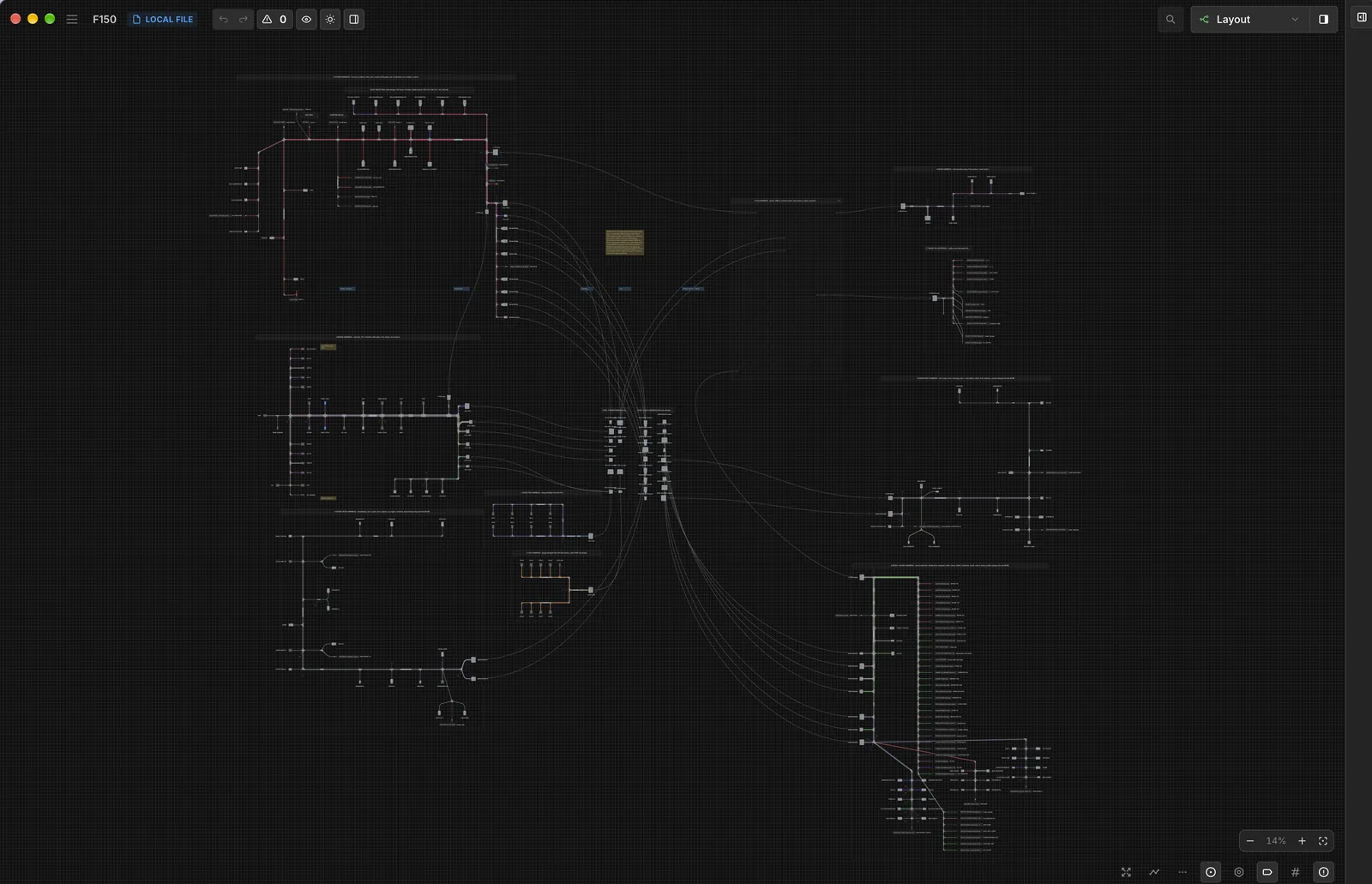
Desktop appPart 1 of 1Drawing 44.1 of 47
F-150 Coyote harness
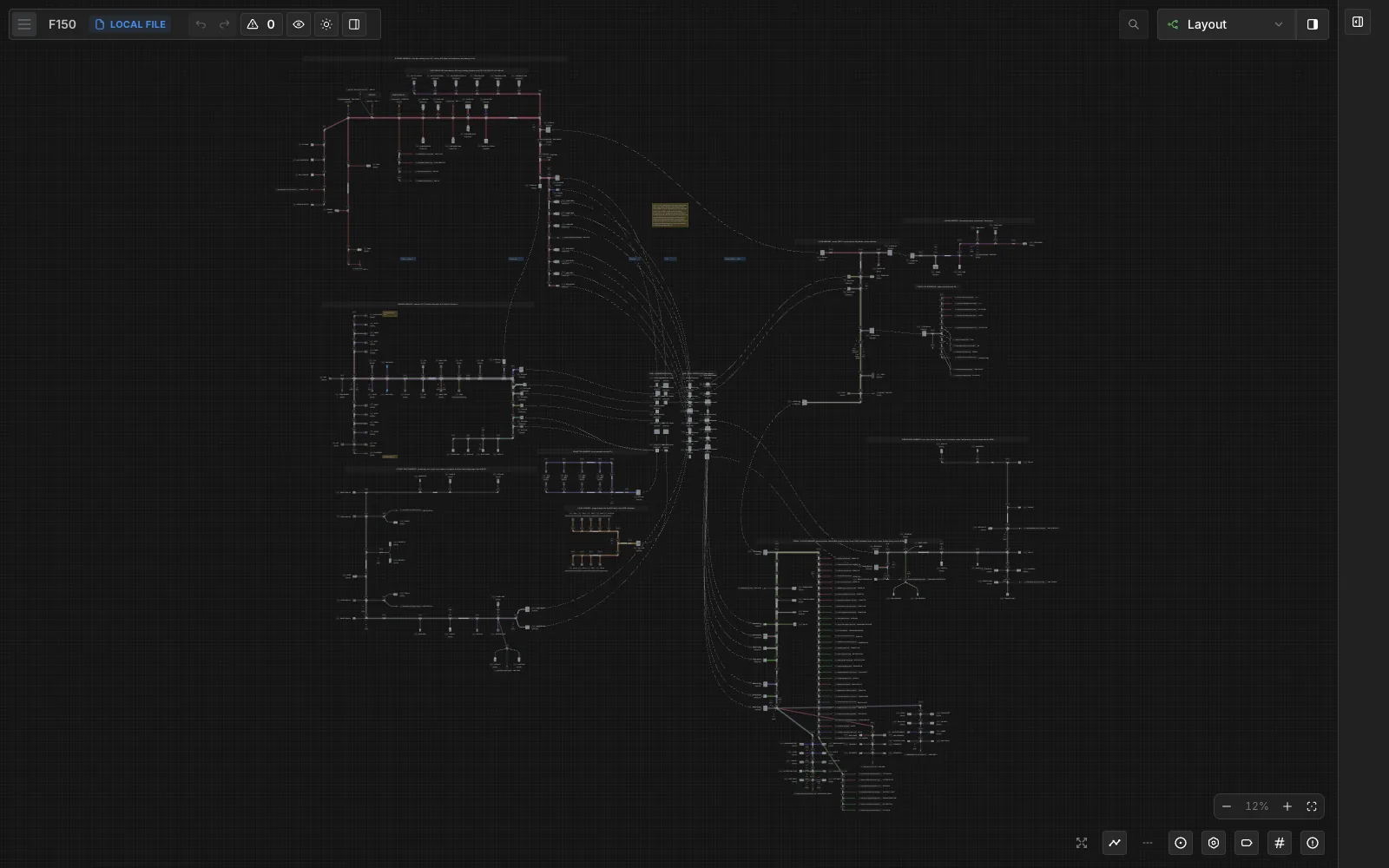
The example: a full harness for a 1985 F-150 with a Coyote V8 swap. Ten harnesses, 512 connections, 266 circuits and a fuse box of my own.
- StatusWorking, version 0.1.0, 2026
- Built withReact, TypeScript, Electron, React Flow
- Runs onmacOS, offline
- File formatthe open .harness format, read and write
- Parts804 in an offline catalog, Deutsch, TE, Molex, JST, Aptiv
- Examplea 1985 F-150 Coyote swap, 512 connections
Sheet 02 of 09/Why
Old truck, new engine
A 2015 Coyote and a 1985 truck were never meant to talk to each other. Rather than splice the two together, I'm drawing the whole electrical system again: engine, power, cab, front and rear body, dash and doors.
Sheet 03 of 09/Layout
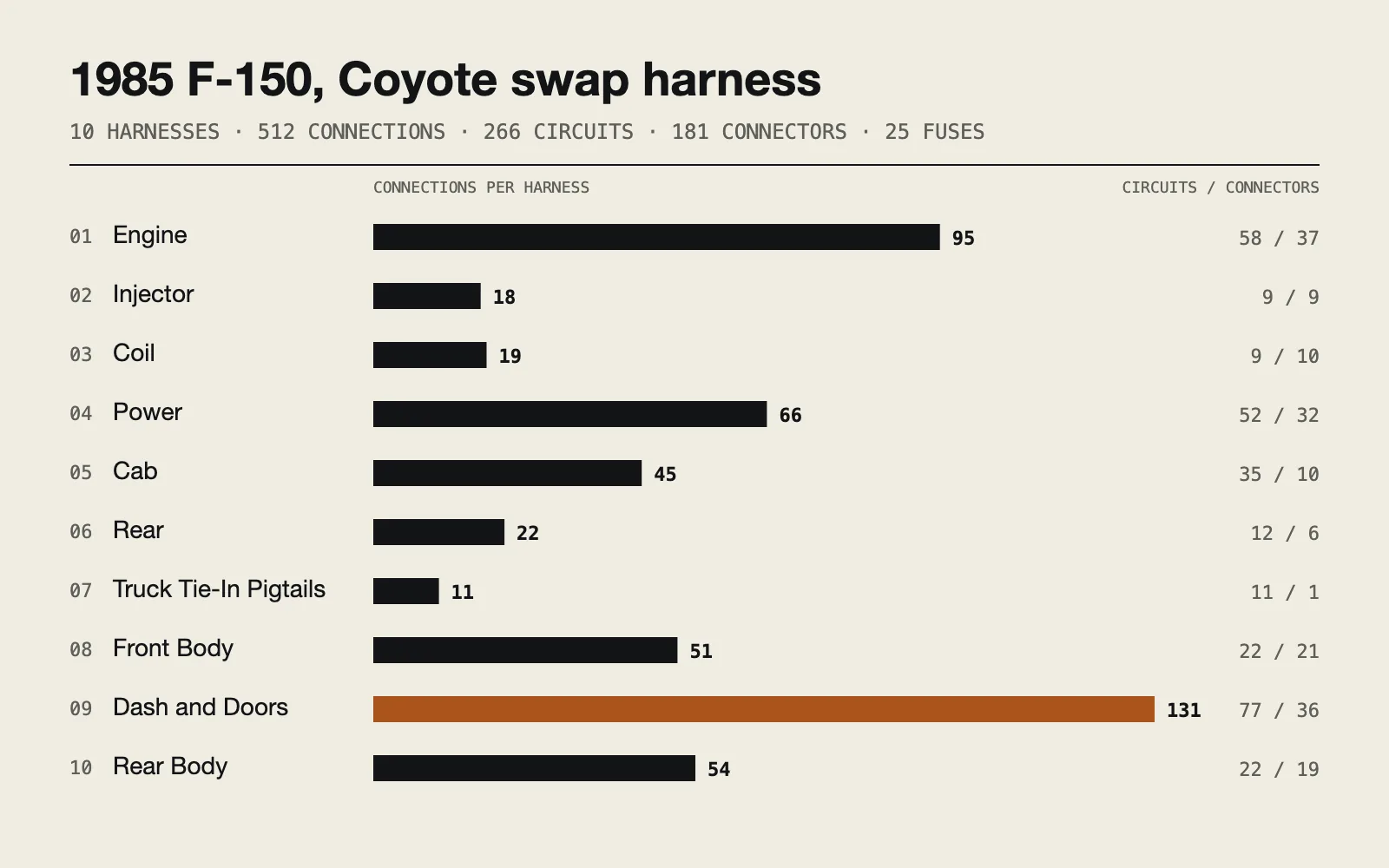
Ten smaller harnesses
It's ten harnesses instead of one big loom. Each one ends in its own plug, so the injectors, the coils and the engine can each come off the controller on their own.
| Harness | Connections | Circuits | Connectors |
|---|---|---|---|
| Engine | 95 | 58 | 37 |
| Injector | 18 | 9 | 9 |
| Coil | 19 | 9 | 10 |
| Power | 66 | 52 | 32 |
| Cab | 45 | 35 | 10 |
| Rear | 22 | 12 | 6 |
| Truck tie-in pigtails | 11 | 11 | 1 |
| Front body | 51 | 22 | 21 |
| Dash and doors | 131 | 77 | 36 |
| Rear body | 54 | 22 | 19 |
Sheet 04 of 09/Controllers
Two controllers of my own
The engine side runs from an engine computer I'm designing myself, and the body side runs from my own body controller behind the firewall. The stock switches are kept and spliced in as inputs to it.
Sheet 05 of 09/Parts
Parts you can buy
The goal was off-the-shelf parts and no special cables. The harness uses Deutsch DT and DTM plugs for its own joints, and factory Motorcraft pigtails wherever it meets a Ford part.
Sheet 06 of 09/Fuses
A fuse box I had to draw
I couldn't find a sealed fuse box that fit, so I designed one. It holds 25 fuses and 6 relays, from 5 amp sensor feeds up to 60 amp feeds for the body controller.
Sheet 07 of 09/Method
Drawn by a script
The whole truck harness is generated by a Python script. Every connector, pin and wire lives in it as data, it writes the .harness file and two spreadsheets, and hexis.harness reloads the file live while I work.
Sheet 08 of 09/Hybrid
A hybrid version, parked
There's also a second file with a Tesla drive unit on the front axle: 13 harnesses and 647 connections. It's parked, because three Model S battery modules give about 68 volts and the drive unit needs 200 to 420.
Sheet 09 of 09/Status
Where it stands
It's a design, not a built harness. Some pinouts still need checking with a meter, 43 parts are marked to verify, and the bundle lengths, the transmission and the engine computer are still open.