Status Work in progress

Sheet 01 of 04/Learning to walk

RoboticsDrawing 03.2 of 25Part 2 of 2

Learning to walk

A policy trained in simulation since August 2026: what it can do, the three things that broke getting there, and why none of it has been on the robot.

Specification / as recorded

Status
Robot built 2021 to 2022, software rebuilt from scratch since August 2026
Role
Co-designed and co-built with Emin Alp Arslan. Simulation and learning work is mine
Joints
12 servos, three per leg, 1.96 N.m each
Mass
3.1 kg
Brain
Raspberry Pi, PWM at 50 Hz, three IMUs on the trunk

Sheet 02 of 04/Teaching it to

Teaching it to walk

The robot is apart on a shelf right now. The work is in simulation.

I train a policy with reinforcement learning: it gets a command, it moves the joints, and a set of reward terms score how well it did. Then I verify the trained policy against fixed criteria, and I film it, so I can see things the numbers do not describe.

The numbers below are all from simulation, 64 robots at once, over 25 seconds. None of them are from the real robot.

The right hand column is the one that matters, and it is the column most result tables leave out. Two different policies produced these rows. One is trained on flat ground and holds the line and the speed. The other is trained on slopes and does the climb. No single policy has done all of it.

Verification criteria / simulation only
CriterionBarResultPolicy
Walks forward5.0 m6.7 mFlat ground
Top speednone set0.72 m/sFlat ground
Holds a straight line7 deg4.5 degFlat ground
Stays upright100 of 100Flat ground
Climbs a 10 deg slope98 of 100 uprightSlope
Walks sidewaysshort by 3 mm/sFlat ground
Criteria passed1110Neither alone

The two pull against each other: train on hills and the straight line costs about 1.7 degrees more. Getting one policy to do both is the next decision, not a finished result, and until it is made this table has to be read a row at a time rather than down the column.

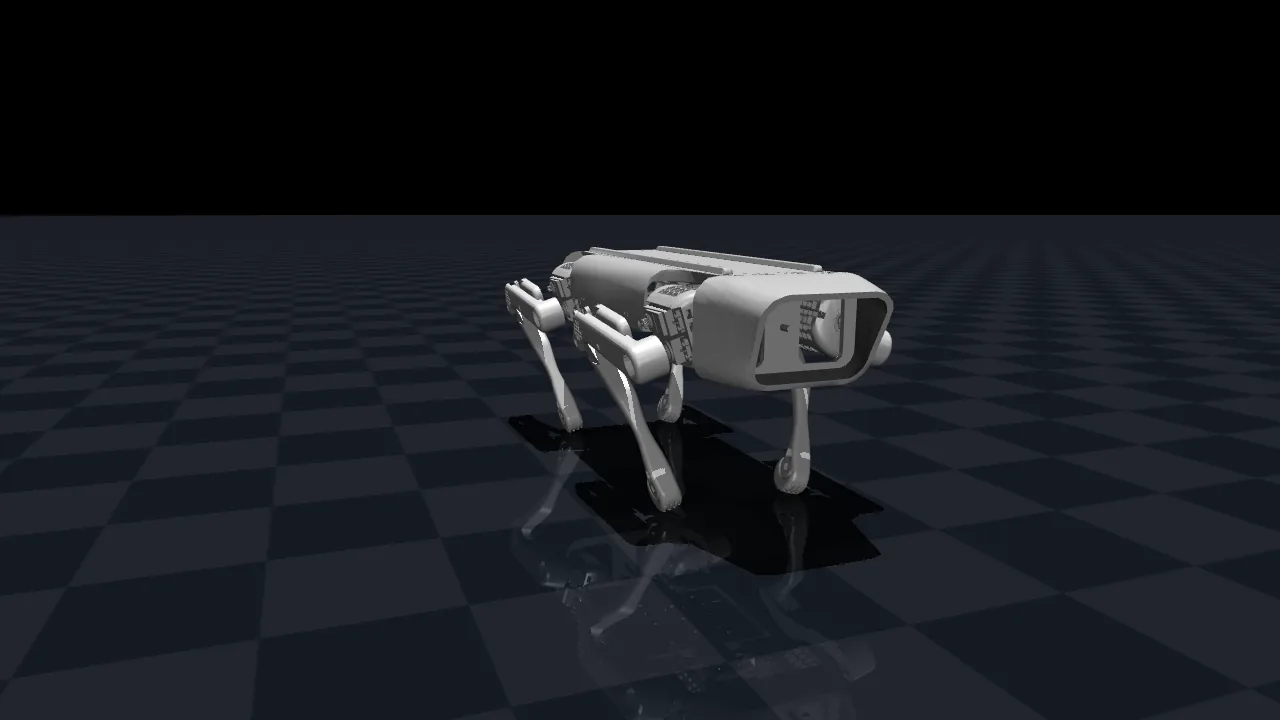
A simulated grey quadruped robot standing on a dark checkered floor
PlatePL-01
TitleSame robot in the simulator
ViewDetail
At the ride height the walk policy starts from.
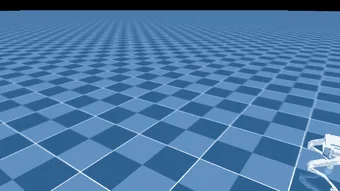
A simulated quadruped robot walking forward across a blue checkered plane, the camera trailing it
PlatePL-02
TitleRun 182 at 7,896 iterations
ViewClip
Driven forward at 0.49 m/s. Over eight robots it covers 2.2 to 3.3 m in eight seconds and none of them fall. This is the newest policy, not the best one.

Sheet 03 of 04/What broke

What I got wrong

I built a whole software stack on a bad CAD export. The model the simulation trained against did not match the robot, so every policy on it was learning to walk as something else. In August 2026 I archived the lot to a git tag and started again from SolidWorks. Nothing carried forward.

Two smaller ones cost real time.

  • A setting in the physics library was quietly clamping the commanded forward speed to at least 0.3 m/s in four attempts out of five, and taking its absolute value. So the policy never trained across the speed range I thought I was giving it. It trained at one speed, and every backward command got flipped to forward. It is the leading suspect for why speed tracking kept failing.
  • The reward table on my training dashboard went stale once. I spent hours explaining a result against a scoring function the run had never used. Now the code refuses to start a run if a new reward term has no plain English note attached.

Sheet 04 of 04/Whats next

Where it goes next

The policy currently trots: diagonal pairs of feet lifting together, the body falling between steps and being caught by the servos twice per stride. In simulation that is fine. On the real robot it asks hobby servos at 50 Hz, with backlash nobody has measured, to arrest 3.1 kg twice a stride. I do not think they will. So the next job is to steer it toward a crawl, where three feet stay planted and nothing has to be caught.

After that: a policy for getting up off the ground, then a rule for handing over between the two, then the sensors. Every joint gets a potentiometer so the robot can finally report where its legs actually are. The Pi has no analog inputs, so that needs an external ADC with twelve channels.

Putting a policy on the real robot is deferred on purpose, not blocked. The cost of deferring it is real: three numbers the simulation is guessing at, servo gain, backlash and loop latency, only get measured on hardware, and every policy trained before that is trained against guesses.